Saturday, September 14, 2013

Another Day In Limbo

Well, today is my 3rd maybe my 4th day in limbo.  It is hard to tell because I’ve been just wandering around the regional house in an itinerant stupor the whole time and the days sort of bleed one into the other.  Why am I in limbo?  For a lot of reasons, but the biggest one being that I am currently incapable of returning to my village.  You see, this is rainy season.  Not only that, but it has been the wettest rainy season in a long time.  There is a stream that basically wraps around my whole village, and with all the flooding that has been going on, it would be impossible for me to cross it with all my bags and my bike.  I suppose I could swim across…

So you might ask, “so what do you do all day since you are unable to get to site?”  Not a whole lot.  I write blog posts, as I’m sure the sheer amount of new posts I’ve written makes evident.  I watch movies.  Like, a lot of movies.  Maybe I should start a movie critic blog to take up some time.  You could say that this is time for me to be productive, I could study Pular, or consider grants for projects, or learn to swing-dance or something.  This would require willpower though, and this has been completely sapped from me.
Maybe it’s just that I’m a lazy man and this gives me an excuse. 

How about an anecdote then?  So last night I was sleeping in the disco hut (the hut sleeping area) and I was the only one there.  I awoke in the middle of the night to the sound of commotion within the hut.  I look out of my bed and looming over me… is a donkey.  Yeah, there was a donkey in the middle of the hut.  That doesn’t really seem very scary, but when you are awoken and see a giant donkey right there, it’s kind of terrifying.  So I made to give an “ACHA!!!” (which is how we shoo animals), but it was combined by a frightened scream to more of an AAAAAAAAAAAHHHCHA!!!


So yeah, exciting stuff.  Anyway, if I don’t get back to village in a week I’m going to go hang out in Tambacounda.  Until then, I’m taking suggestions for skills I can learn.

Thoughts Of A Cattle Driver

If you had asked me 5 years ago what I would be doing in 5 years, I wouldn’t know what to tell you.  5 years ago was September 13th, 2008.  I was a freshman in college, Varun hadn’t yet moved into my dorm (Hi Varun).  I was an undeclared major taking an English class, a Political Science class, a Math class, and a Chemistry class.  I clearly had no idea what I wanted to do.  And you know what?  I still don’t.  But if you had told me 5 years ago that in 5 years I would be a farmer, herding cattle, I wouldn’t have believed you.  For obvious reasons.  I mean, who herds cattle anymore?  Are there any cowboys left or is it just huge industrialized farms?  I actually don’t know.  This wasn’t a rhetorical question, if you could let me know in the comments or something, it would be appreciated.

So my friends and family ask me what I do here in Senegal.  You know, like on a day to day basis.  I guess in the long run I’m supposed to be involved in bottom-up, community driven, capacity building, sustainable (and all those other fun Peace Corps catch-phrases) development.  But that is not my reality on a day-by-day basis.  I am a farmer.  Through and through.  I wake up in the morning, eat breakfast, and then go out into the fields.  Each member of my family has their own field, even the women.  It is interesting that in a society that has such great disparages in gender equality, when it comes to farming it’s very egalitarian.  The women own fields, they plant their fields, and they tend their fields. 

In my village there are three crops: corn (kaaba), peanuts (tiga), and rice (maaro).  When I say that I go out into the fields, I think I might be too generous to myself, because I actually do very little work.  It’s like my family sees me as being completely incapable, which is understandable because I have the language prowess of a kindergartner.  So I’ll go out and plant a few peanuts, and then they’ll say something along the lines of “good for you, you can stop now”.  I try not to let their seemingly belittling words get to me.

Just some notes on vocab:
To plow: barugol
To plant: awugol
To till (I still have no idea what tilling is): ussugol
To find your cattle: dappitugol na’i
To herd you cattle: soggugol (ACHA!!)
To tie up your cattle: hummugol na’i
To sit in your field all day to protect the corn from being eaten by the cattle: aynugol

 I said earlier in this post that I was a farmer.  This isn’t entirely true.  In reality, I’m a cattle-herder.  

look close, there's a rainbow!

As you can see, my language is very cow-driven.  People hear me talking about all these specific Pular verbs and are like “wow, you’re really good at Pular”.  Not so!!!! I just have a very specific cow-specific vocabulary. 

Every evening I go out to the cows.  Literally, that’s what it’s called.  When someone asks you “ko honto yahata? (where are you going?)” The response is “mido yahude ka na’i (I’m going to the cows)”.  So we go out to the bush to find our cows and then herd them back to an allotted area near the soccer field.  This is where we tie up the cows.  You might ask, “how do you tie up the cows”.  I thought the same thing the first time I went out to the cows.

Basically, there are stakes drilled into the ground that have ropes attached to them.  When the cows are driven in you tie the rope around their horns.  This of course is to keep the cows in one place during the night so they don’t wander around and eat people’s corn.  Apparently there’s a village rule where if someone’s cows eat someone else’s corn, they are entitled to monetary compensation.  So anyway, the hard part is keeping the cows still.  In order to do this, you have to reach out your hand palm up.  The cows think that you have salt in your hand, so they walk over.  Once they are close enough, you shoot out a hand and grab one of their horns. 

[Disclaimer: cows do not like this.]

But in all seriousness, the cows are pretty docile.  They’ll try to tug away, but they won’t try to run you down.  I of course didn’t know this the first time I tried to tie up the cows, and it was a rather terrifying experience.  Sometimes when the cow is really not having it you have to use both hands and drag the cow over to the rope.  I won’t lie, it does make me feel pretty manly literally manhandling cattle.  Seriously, I grab the bull by the horns.  Once the cow is tied up, you move onto the next.

Interesting note about cows #1: All the cattle are tied up at the same place every night.  Sometimes I try to tie up the wrong cow and get yelled at by my host brothers.  You might be thinking to yourself, “why does it matter so long as all the cows get tied up?”  I have no idea, it’s really important to them though
.
Interesting note about cows #2: The cows know where their tie up spot is.  This means that when you are herding them, once you get to the tie-up area they generally go to the spot they’re supposed to be tied up.  Seriously, they’re pretty smart.

Interesting note about cows #3: All of our cows have individual names, and everyone in my family knows them by name.  It’s pretty funny hearing my host mom yell at Aysatu for being a lazy cow.  It’s true though, she is lazy.

Interesting note about cows #4: Cows have personalities.  Seriously.  I haven’t gotten to know all of my cows yet, but some of them are little calibantes (rascals).  For instance, Ibu always tries to get tied up in the wrong place until you realize it’s the wrong cow and ACHA! him.  Then he’ll go back to his spot.  I honestly think that he’s trying to get closer to Aysatu, there’s clearly something going on between the two of them.  It might be sort of one-sided though, it’s obvious that Ibu is into Aysatu, but I’m not sure if she realizes it yet.


I spend too much time with cows.

Beef Anyone?

Remember that time I told you that I was biking back to village in the middle of the night because I left the regional house too early?  No?  Well, go back and read my blog!  Ok, now that you’ve re-familiarized yourself, time for an update!  So I was walking my bike in the pitch black considering all the bad things that could happen.  I’m too far from the park for there to be lions, right?

Well, when I get back to village from the Pecadom Plus project, it’s dinner time.  As I sit there waiting, my host brother comes out with a plate full of beef.  Now, beef is a rare commodity out here.  See, cows have a weird economic value in Pular culture.  They’re sort of used as a store of wealth.  So when people have money, they buy cows.  When they need money, they sell cows. But they never kill, cook, and eat cows.  I guess it makes sense in an abstract way.  Anyway, this is why I am confused to be handed a plate of beef.

“Why did you guys kill a cow?” I asked.
“What do you mean?” was the response.
“Well we’re eating beef”
“Oh yeah, we totally didn’t kill the cow, les hyens did.”

 (Ok, this this conversation is in French.  I don’t know what “hyens” means, but it sounds a lot like Ian.  I was wondering if Ian Hennesy had come back to slaughter our cows.  Occum’s razor ruled this out though.  After a few minutes I realize it sounds like “hyena” and confirm that this is what they mean.)

So apparently the people in my village heard the death-cries of the recently dispatched cow.  They ran over and all the commotion scared off the hyena.  They saw the dead cow, thought “ehh, why not”, cooked it and ate it.  One might question the wisdom of eating a cow that was killed by a hyena, but I ate it and didn’t sprout fur or anything, so I think it’s fine.


It didn’t hit me until later though.  Remember that one time I pushed my bike through the darkness for a couple of hours trying to tell myself there was nothing out there.  Yeah, there were things out there.  

There were hyenas.

And not the fun kind:
be prepared.

Pecadom Plus Day 5: Just What Exactly is a Jolonke (Welcome To Mande Paradise)

The fifth and last day of Pecadom plus dawned and I was rather tired.  I’d been biking and driving around for four days now, and on top of that was the frustration of trying to assist these dsdoms using my limited French and general lack of communication.  So I don’t think I was in the wrong to be sort of dreading what the day would entail.  Would the car burst into flames?  Would a flash flood strand us indefinitely?  Would it be another frustrating day of appeasing hypochondriacs? 

So on this final day we would be going to the far south-east of the Saraya region, into Jolonke territory.  You might ask, “what is a Jolonke?”  I’m glad you asked!  Well, I don’t really know very well.  They’re a sort of Mande people, but apparently they’re far sundered from Malinkes or Jaxankes.  What do they do down there out in the bush?  Who knows?  They’re so far isolated that Peace Corps does not train anyone in Jolonke. 

Hello Jolonkes

So there were four of us going and only three villages.  Good news right?  That means that I could double up with someone who spoke a Mande language so I wouldn’t have to struggle through it in French.  Wrong!  Jolonke is so different from Jaxanke that Chad couldn’t understand anything they were saying, and since he doesn’t speak French… that’s right, another day of broken French!!!

YEAH!! BROKEN FRENCH!!!

So we get to the health post, give a causerie to the dsdoms, and were on our way.  The dsdoms were saying how the road was too rough and there was a giant hill that couldn’t be ascended.  Did that stop Tidiane?  Not at all.  We slog through the rough road until we finally get to the giant hill… and it was this hill that finally defeated him.  I kind of wanted him to try to ascend it, just for his track record, but the car had already taken quite a beating, so he didn’t try it.
So we get to the village which is named Wamba.  That’s right: Wamba.  This day is already awesome just because of how amazing the village name is.  We get there and guess what happens?  Everything goes according to plans!  We go to each compound, we ask who’s sick, we take their temperature, if they have a fever we give a TDR, and if they come up positive we distribute ACTs.  Wasn’t that easy?!  Why couldn’t it be like this is every place?  Seriously, this was like some kind of Mande paradise.  Let me paint a word picture for you.  Imagine rolling hills with a quaint village on top.  As you enter the village you see animals in the street.  But wait, they’re in great shape!  I’ve never seen animals look so good in Senegal.  People were petting the dogs and letting the cats cuddle up to their feet.  It was like I entered some sort of Mande twilight zone.

Also, I got to take some great pictures of Chad apparently assaulting Senegalese children:

Come now Chad, what did she ever do to you?

Anyway, I was happy to end my Pecadom Plus adventure in such a pleasant area.  Of course, we got rained on biking back, but the pros of my experience far outweighed those cons.  If Peace Corps trained Jolonkes, I would really suggest that site.  Of course, they’re like literally in the middle of nowhere.  I guess when the new stage gets there just ask “who is willing to live out in the middle of nowhere with little to no possibility of ever leaving site or going to the regional house?”  “Also, you’ll speak a language no one has ever heard of, so you must be fluent in French!” I’m sure there would be at least one.

And that was it.  We drove back to Kedougou in Tidiane’s car, listening to Tidiane’s very thoughtful views on Islam and Christianity.  I arrived back at the regional house just in time to catch the tail end of Emily’s birthday party, and I even got cake.  All’s well that ends well.

Pecadom Plus Day 4: After Me, The Flood

The fourth day of Pecadom started a lot more chill than the previous few days.  This was because the number of us had shrank from 15 to 3.  I kept on keeping on because I really enjoyed going around to all these cool places and because it was refreshing to be a part of a project that actually was set up with a research design element with observable outcomes.  There were only 3 of us because a few had gone back, some had gotten sick, and Karin and Frank were going to sites close enough to Saraya where they could bike.  So Anne, Chad, and I went to the health center and one of the drivers there was kind enough (and foolish enough) to agree to drive us.  This day we would be going to the health post in Bambadji, and decide who would be going where from there.  Map for reference:

Go east young man!

Let me tell you, that road was not very good.  Like seriously though, it took us forever to get there.  There was only one dsdom with good French, so I was assigned to him.  We’d all take the car, we’d drop off Chad, then me, and then Anne.  On the way there we crossed a pretty considerable river, but were able to make it through. 
The river isn't that bad

  We dropped off Chad, then we got to my village.  The village I was assigned to happened to be the site of Mike Majors.

I think this point in the story deserves a bit of a tangent about Mike Majors.  He’s known as “Peace Corps Mike” because he served in the Peace Corps in three different countries.  He started out in cape verde.  Apparently there were a bunch of Chinese store owners, so of his own volition, while there, he learned mandarin Chinese. Why not?  He then went to Peace Corps China.  It still blows my mind that there is Peace Corps in China.  Their experience must be so much different from ours.  Could you imagine doing Peace Corps in China?  Anyway, from there he apparently applied again and got sent to Senegal.  I hear that he didn’t like his site so he up and relocated himself. 

Back on point, when we got to my village my dsdom said he wanted to continue on to Anne’s village because he was afraid that we’d get lost.  Long story short, we went all the way to Anne’s village and then it started pouring.  Like torrential.  I had never seen so much rain in my whole time in Senegal.  Of course, we’re in the car trying to get back to my village through this deluge, bouncing around and flying through puddles that were turning into rivers and rivers turning into lakes.  We eventually made it, alhamdoulilai, and I got drenched making it to the dsdoms house.  We waited there for a long time for the rain to subside.  When it finally did, it was time for the sweeps…

…but it ended up basically like the day before.  We went to one compound and people from all around the village started coming to get tested.  So this woman with her daughter walks up and says that her daughter has malaria.  When I asked what signs or symptoms she has, the mother basically said that she didn’t have any, but she could tell that she had malaria.  We take her temperature (since our thermometer actually worked), it came back negative for fever. I turned to my dsdom:

“She doesn’t have any signs or symptoms of malaria and we have limited tests,” I say
“I think she has malaria.” He replies
“But she doesn’t have any signs and no fever”
“I think we should test her anyway”
“why?”
“I can see that she has malaria in her eyes,” was his rebuttal
“what does that mean?”
“Look at her eyes!”
“Yeah, I’m looking, but she doesn’t have a fever”
“We should test her anyway”
“But it will come back negative”
“And if it doesn’t?”
“I am sure it will!”
“but if it comes back positive, what would you do?”
“I don’t know, I won’t humor that thought because it won’t come back positive”
“then let’s test her.”
“OK, let’s”
…And it came back positive.  Darn.  I just lost all of my credibility in this village for the rest of time.  For the rest of the day he could always give me a knowing look, and I’m almost positive he gave me a wink every now and then when I was skeptical of someone’s malaria claim.  Like “hey, how about her, don’t think she has malaria too?”  It was overall a negative experience. 

Anyway, we made it back to Bambadji as the sun was setting.  Bambadji was actually a pretty nice place:

Mommy, why is that white person taking a picture of us?

 And we were on our way back to Saraya.  However, the heavy rains from the daytime had made a marked difference in the terrain.  We get to what was once a considerable river, which is now raging.  The driver gave quite a few skeptical glances at it, considering whether it would be worth it, weighing pros and cons.  Anyway, we decide to try it.  As we enter the flood the water starts to slowly rise along the carside.  I was looking out in anxiety when all of a sudden everything went dark.  See, it was nighttime and the only light we could see was from the headlights.  The darkness resulted from the water rising above the level of the headlights as we plowed through the river.  At this point I thought we’d be carried away by the current, never to be seen again (possibly in the Gambia).  However the car miraculously made it across.  I didn't know how it made it and I still don’t. 


With that excitement behind us we trudged along through the sarayan bush back to Saraya.  We hadn’t see any signs of civilization for a few hours when we arrived in a small village 10k outside of Saraya.  It was in this village that our car broke down.  We had to wait around for about an hour , but the health center sent an ambulance that rescued us.  I still shudder thinking about the alternatives.  If we had broken down a little while earlier, we would be in the heart of the bush, many miles away from civilization, without reception.  I don’t know what we would have done.

We collapsed back into the Linn Inn at around midnight to discover that the ceeb that Karin and Chrissie had gotten for us had turned cold.  We ate cold ceeb thankful to be back, and then passed out.    

Pecadom Plus day 3: Wait, Are We In Mali?!

Ah yes, day 3 of Pecadom, I remember it like it was yesterday.  So basically the plan was for the seven of us to drive to the village of Daloto where the poste de santé is. Here's a map:

Seriously though, did I go to Mali?

 It was a pretty uneventful ride through the sarayan bush (it’s like a savannah woodlands over there).  It only took like 2 hours.

typical Saraya

 When we got there Anne gave a causerie to the dsdoms talking about the sweeps and what their role was and what our role was.  I was pretty bored at the meeting because I don’t speak Malinke, so my eyes wandered around to the faces of all the dsdoms.  Wait a second, is that kid a dsdom?!  Seriously, the dude is like 15 years old, he must be the son of one of the dsdoms… nope, he was wearing the hat and everything.  As I perplexed over the wisdom of ordaining a 15 year old a dsdom, Anne finished her causerie.  Apparently a few people were to ride their bikes from Daloto, while me, Janelle, Chrissie, Chad, and Taylor, would continue on to a new village where we would bike from.

Ok, now we’ve got that all settled, it’s time for lunch!  Guess what’s for lunch?!  ITS MORE CEEB!!!!!!  Yeah!!!
CEEB!!!!!!!!!

As we waited for them to finish the ceeb a bunch of Senegalese children came up to look at the gaggle of toubabs (I think the collective term for toubabs is a “gag
gle”).  There was one little girl who came over to Chad and was hanging out.  Sometimes they like to just stand around toubabs, they don’t really say anything, they just kind of sit there.  Anyway, she turned around to look at her friend, and as she was looking two more of us toubabs walked up and started talking to Chad.  The little girl turned back around to see three toubabs where there was once one.  She gave a quizzical look, but then turned back to her friend.  This was when I walked up to talk with Chad (he’s a popular dude).  The little girl now turns around to look at four toubabs.  The look of sheer panic I can’t get out of my head. 

TOUBABS!!!!!!

I could just imagine her thinking “THEYRE MULTIPLYING!!!! ABORT!! ABORT!! ABORT!!”, and she starts booking it away as fast as possible.  This is nothing new, little kids are often terrified of white people.  What was hilarious though was while she was running she’d every now and then turn her head back around to look over her shoulder as if to make sure that we crazy toubabs weren’t chasing after her or something.  And she wouldn’t stop running.  I lost sight of her as she had made it all the way to the other side of town still running in sheer terror.  I am convinced that to this day she is still running away, every now and then looking back to make sure we’re not hot on her trails.

With lunch over we piled into the car and drove off to the village where we’d be splitting up.  Now I’d been told that I’d have a 9 kilometer bike ride after we’d arrived at the village.  However, when we get there Tidiane informs me that he thinks it’s a little further and that he’d be driving me.  This is good news because I wasn’t looking forward to riding my bike.  Well, we spend like an hour and a half in the car, it was definitely much further than 9k.  It was great having some quality time with Tidiane, he’s a really cool guy and speaks like a billion different languages.  Oh, I forgot, the dsdom was with us in the car.  Now the dsdom is convinced that we can’t make it all the way to Moussala, his village, in the car.  Tidiane had other ideas. 
We truck through some rough terrain and bad roads until we get to a river.  Well, it was more like a stream.  It wasn’t too deep, but the slope on the other side was nearly sheer.  Not only that, but it had really loose gravel, bad traction. This is what it looked like:

One does not simply drive into Moussala

I was convinced that the car wouldn’t be able to make it.  Tidiane said we’d try anyway.  Tidiane is a boss, ‘nough said.  We all get out of the car as he guns it up the hill and… it loses traction and slides back down.  We then reconsider the path we should take and throw down logs over the more loose sections.  He once again books it and barely makes it over.  I’m still impressed that he tried, and more impressed that he made it.  We finally make it to Moussala, which by the way is right across the river from Mali.  It was like “wait, am I in Mali?!” 

Anyway, the dsdom says that he needs to get some stuff from the health hut, so we make our way over there.  Bad decision.  As soon as we enter the building people start coming over to see what’s up.  The dsdom asks if we can diagnose these people here at the health hut.  I tell him that this would completely defeat the purpose of pecadom plus, you know, the part where we go around to all the compounds and ask about malaria, not them come to you.  As I’m explaining this one of the girls who was waiting there starts vomiting all over the floor.  Yeah, we should probably check to see if she has malaria.

 Sure enough she did, and vomiting is a symptom of severe malaria which can’t be treated with the ACTs that the dsdoms are given.  We refer her to the health post, but now everyone in line wants to get tested.
Basically we got bogged down in the health hut and weren’t able to actually go around to each individual house because it would be kind of pointless just having this big crowd of people follow us around.  I try not to be skeptical or jaded, but it’s hard at times.  I mean, these people in this village see that there is a free malaria test being given, why not go over and see if you have malaria?  The problem is that there aren’t enough tests for everyone, so only people who present signs of malaria are given the test.  So let me give you example of some of the conversations I had (I’m copyrighting this dialogue in case I try to turn it into a one-man play):

Danfakha: I think I have malaria.
Chris: Oh, what signs or symptoms of malaria do you have.
Danfakha: You know, malaria signs.
Chris: malaria isn’t a symptom of malaria. (right?)
Danfakha: Well then, I have a back-ache.
Chris: That’s not a symptom of malaria, I’m sorry, but unless you have signs or symptoms, we don’t have enough tests to give everyone.

Exit Danfakha stage right.  Enter Danssokho stage left

Chris: How may we help you?
Danssokho: I think I have malaria.
Chris: what symptoms?
Danssokho: I’m not sure, I just feel like I have malaria.
Chris:  wait, do you have aches in your left leg and sneeze if you look at the sun?!
Danssokho: Yeah!  Both of those!
Chris: Those aren’t signs or symptoms of malaria, I’m sorry, we can’t treat you.
[Disclaimer: This literally happened.]

End of scene I: intermission
Scene I, Act 1,
Setting: Me still in the health hut, the sky getting darker as a storm approaches.  Enter old woman stage left

Old Woman: I have malaria!
Chris: What signs or symptoms?
Old Woman: I have aches in my joints and I get cold at night
Chris:  Those aren’t signs or symptoms of malaria, those are signs of being old.  Massa.

Ok, but really this is just a snapshot of my day.  It got really frustrating because I wanted to help people and if we could I’d give the test to everyone, but we just didn’t have the resources to do so.  Does that make me skeptical or jaded?  I’ll let you decide.  Whatever your choice, I am convinced that all Danfakhas are hypochondriacs.  It does make sense though.  These people are
concerned about their health.  They have aches and pains and coughs and why not see if it’s malaria if it’s free?  I don’t know how to address this problem.
Anyway, as we diagnosed and tested people, the sky above got darker and darker.  The dsdom kept insisting that we hurry or we would get stuck here when the rain came.  I went and consulted Tidiane, and we both agreed that we would have to cut it short because the rains were coming and the river would get too high for the car to pass through.  As we drove back the rain began.  We luckily were able to make it through the river, only submerging the car to the wheel-axel.
 
When we arrived at the village we’d set off from we found Chad and Janelle (they were soaked because whereas I was in a car when it started raining, they were out in the open).  Apparently they too had to cut theirs short because when they were in a compound a little kid came out with a spoonful of mercury and rock ore getting ready to burn it to extract gold.  Yeah, they shut it down after that.  They didn’t want to end up like this:
Seriously though, burning mercury to process gold is a serious problem and shouldn't be taken lightly.  It's a serious issue

So we rode in the car back from our separate adventures.  Back at the Linn Inn we talked about how frustrating the day was and how we weren’t able to finish.  The consensus was that we had sampled enough to make it representative and the approaches would be similar to the actual Pecadom project, since these were the control towns and we were just trying to establish a baseline.  For dinner I had petit-pois.  It was tasty.  I went to bed that night still frustrated, hoping the next day would end up better.  Would it?  Would Chris’ French be sufficient in the next village to actually be able to understand what is going on?  What whacky adventures would he get in next?  Tune in next time to find out!

Friday, September 13, 2013

Pecadom Plus day 2: The Sweeps

I woke up on the second day of Pecadom Plus with hope and anxiety.  Hope that the day would go better than the day before, and anxiety having the knowledge that it probably wouldn’t.  Am I a pessimist?  I don’t like to think so, I like to think that I’m a realist.  Not in the waltzian sense (polis ci majors… anyone?)  We got our stuff ready and I find myself riding my bike down that glorious paved road.  Since I actually know now where the dsdom lives I rode on over to his house.  The day before I had delivered the supplies of the ACTs, the TDRs, and the thermometer.  When I arrived I asked him if he was ready to go.  He said he was, but there was a problem: the thermometer was broken.  “How is it broken?” I ask.  “The mercury won’t rise.” Sure enough, the mercury wouldn’t rise.  Shoot.  Now what?  Well, the thermometer is an integral part of the whole process because it helps to identify fever, and the severity of the malaria.  I tried to call Anne to ask what I should do.  Oh wait, there’s no reception… of course.  Ok, so there’s extra thermometers at the health center.  Ah man, am I going to have to bike back to Saraya and back?  Nah, the dsdom has a motorcycle he can use.  OK good, so go get the thermometer, I’ll wait here… and he didn’t have any gas.  So I had to front a mil CFA for the gas and he was off.  He returns like 2 hours later.

“I found a few thermometers.”
“That’s good, now we can start.”
“…yeah… none of them work.”
“So we spent like 3 hours and still don’t have a thermometer?”
“Basically, but I can use the back of my hand to feel if they’re hot.”

(that doesn’t sound very scientific)

“Ok, let’s just start anyway.”

So we begin our sweeps of the village.  Everything is going alright, except for one thing.  Instead of showing up to the compound and asking everyone if there were sick people there, he would just stroll into the compound, say what amounted to “whaddup” and start feeling their foreheads.  Like, “hey, how are you?” BAM!!!! Back of the hand to the face.  It was actually pretty hilarious seeing the expression on people’s faces as they were surprise-fever tested.
 As we came to more houses and I tried to explain the process to him, he would start introducing himself and talking about the signs and symptoms of malaria and asking who showed those signs.  More like what I was told the dsdoms would be doing.  However, he would still go around to everyone and feel their foreheads.  Maybe he just liked feeling people’s foreheads, I’m not sure.  One time we came to this household of about 8 men as they were gathered around watching a soccer game.  As the dsdom went over to ever so gently feel each man’s foreheads the rest of them would crack up laughing seeing the look of sheer discomfort and confusion on the face of their friend.  I thought it would take forever (and it did). 
In our sweep we found 5 active cases of malaria.  I think I’ll always remember that first malaria positive test.  It just made it so real, this child actually had malaria, and if nothing was done she might die.  This child, right in front of me.  I’d always heard about malaria, but I’d never seen it.  I guess before learning about malaria it’s all abstract notions and I’d never had the chance to tie it to real people, to real faces.  It really validated why I’m here and instilled a further drive to do all that I can while I’m here. 
The rest of the pecadom sweep went pretty well.  We had our second causerie that was much better attended, and everyone got a grab-bag to take home (it was maggi cubes, which are basically MSG bouillon, it actually makes things really tasty).
I returned to the Linn Inn late again because of the added event of the causerie.  I think I ate ceeb.  I can’t really remember, but considering it’s like one of three possibilities, I’ll take my chances and say I ate ceeb.  Anyway, I went to bed that night slightly frustrated about the rampant and superfluous head-feeling, but in retrospect this day of sweeps went better than any of those to follow…


Pecadom Plus Day 1: To Causerie Or Not To Causerie

I arrived in Saraya and we all went to the Linn Inn.  The Linn Inn of course is the hut of the Linn’s (Pat and Anne).  It’s a rather large hut since there’s two of them and I’m super jealous of it.  Also, Pat like rigged the whole thing up with ropes and pulleys and whatnot to the point where I’m pretty sure in case of a flood we could sail it down the Gambia to safety.  Regardless of how awesome the Linn estate is, we divided up the TDRs and the ACTs.  I was to go to Dalafing to shadow the Dsdom there.  


 Yay maps!

It was only like 7k away on a paved road.  But seriously, the road was paved.  It was like an American road.  I can’t stress how nice it is to ride a bike on a legitimate paved road (It’s paved because its on the road to the gold mines and the gold companies fronted the resources to get it paved). 

LOOK AT THE ROAD!!!!!

                So I arrive in Dalafing and call the Dsdom to arrange where to meet him… and there’s no reception.  Shoot.  Ok, now what?  This is going to be awkward.  I pull over to the side of the road at a random guy’s house to ask where I can find him.  “Ou est-ce que je puex trouver monsieur Danfakha?” (I’m pretty sure that means “where can I find mister Danfakha”).  Fortunately apparently everyone in Mande territory knows each other, and he directed me to the Danfakha residence.  Unfortunately the dsdom wasn’t there, so I had to sit there awkwardly for about half an hour unable to communicate because I don’t speak Malinke and they didn’t speak French.  So the dsdom arrives, now it’s time to get down to business.  I tell him in broken French who I am and that we can get started with the causerie (a causerie is basically a meeting where someone presents information to the group.  The dsdoms give causeries to the women’s group about how to identify malaria and what to do if they believe someone has malaria.  I was told that they were supposed to give a causerie when I got there.)

“What causerie?” he responded.
“You know, the causerie that you’re supposed to give to the women’s group.”
“There’s no causerie today…”
“But they told me that you were supposed to give a causerie today…”
“yeah… that’s tomorrow.”
“No, the sweeps are tomorrow, the causerie is today.”
“Oh… well, we can call a meeting today then!”

So basically we go to the chief’s house and tell him that we need to throw a causerie.  The chief is understandably perplexed, but with some persuasion we get him to agree.  As he walks off into the sunset to gather the women I hear the fading clarion call of a gilded horn carved from the horn of the mightiest ram seen in these parts in a hundred years, sounding its voice to assemble the masses.  Not really, but that would be pretty cool.  He just went to different compounds and asked people if they would come.
There was a pretty poor turnout of only about 15.  That’s understandable though because people have stuff to do and can’t drop everything to listen to a toubab talk.  With everyone there, the dsdom says its time to start the causerie.  

He turns to me and says, “let’s start.”  “Ok, then begin,” I tell him. “…yeah, you’re giving the causerie, you’re white and it would be better if it came from you”.  I’ve never given a causerie, my public speaking skills are subpar, and I can barely speak French.  However, we were given a handout in French outlining the key parts of the causerie, and apparently since being white carried so much weight, I started talking about malaria.  It was dead silent, blank stares looked back at me as I tried to explain the signs and symptoms. At the end of what seemed like forever I asked “are there any questions?”  There were none… because literally no one understood what I said.  None of them spoke French.   The Dsdom then started talking in Malinke, saying what I assume is the exact same thing, and facilitating an engaging conversation. 

Seriously, why did I make a fool of myself in French if no one would understand me and it would just be repeated in Malinke?  Oh well, C’est Senegal Quoi!  The Dsdom said that we would give another causerie the next day, you know, because no one actually came.


With the causerie finally over, I biked back to the Linn inn.  I was supposed to get back at around 4, I got back at 8.  We went out to eat in Saraya (which is actually a pretty nice place, the restaurant was excellent, some good ceeb bu jeen).  And as I went to bed that night after the frustrations of the day I couldn’t help but fall asleep to the thought of “what could the next 4 days possibly have in store for me”.

Pecadom Plus: Introduction

About two months ago I was able to participate in the Pecadom Plus project started by Ian Hennesy and currently being run by Anne Linn.  Pecadom Plus is a malaria initiative that piggbacks on the Senegalese ministry of Health’s Pecadom initiative.  Pecadom stands for “something something a domicile” (I don’t actually remember what it stands for, but it’s in French, so it sounds cool).  Anyway, it’s a project where they train a member of a village that is over 5 kilometers from a health structure to act as the community malaria worker called a dsdom.  They’re trained to diagnose cases of malaria and are given ACTs (artemesinin based combination therapy) to treat simple cases of malaria.  If the cases have progressed to a severe state, they are told to refer the person to the closest health structure where they can be given a quinine therapy.  Anyway, the PLUS in the Pecadom plus model turns the passive Pecadom model into an active model.  In this model the dsdom, instead of waiting for individuals of the village who feel sick to come to his house, once every week goes on a sweep of every house of the village to actively search out the cases of malaria.  This is an improved model because one can imagine a scenario in which a person is too sick to go to the dsdom’s house to get treated.  Thus with active sweeps this person would be identified and treated.  Anyway, that’s the boring details.  This is actually a pretty cool project, now let’s see how it worked out in practice. 
                Are you buckled up?  Is the safety harness on?  Is the tray put up and your seat in an upright and locked position?  Well then, come take a trip with me, down memory lane, to the five days of my life spent helping out on the Pecadom project.  Let me paint a word picture for you.  You’ll laugh, you’ll cry, you’ll be mildly interested! 
                So this project took place in the Saraya district of Kedougou, which is mande territory.  It was actually a part of the Mali Empire of the 14th century.  Apparently one of the leaders of the Mali Empire, Mansa Musa, was one of the richest men in history.  The story goes that during his Hajj to Mecca he gave out gold so freely that it destabilized the global gold market.  Whatever the veracity of that story is, there were a lot of gold mines in the old Mali empire (and there’s still gold there, as the recent gold boom in Kedougou evinces).  The Saraya district was also a part of the more militarily powerful Songhai empire.  Askia the Great’s burial mound in Gao is a world heritage site (Too bad I can’t go to Mali). 
                Anyway, tangents aside, they all speak mande languages over there: Malinke, Jaxanke, Jolonke (but nobody really know what they do out there in Jolonke land).  I, however, speak Pular.  This posed various problems, the largest of which being that I wouldn’t really be able to communicate with the people there.  However, since I really only needed to shadow the dsdom and only really needed to talk to him, French would suffice (assuming that the dsdom also spoke French).   See, my role in the project would be to shadow the dsdom and make sure that he was going to every house and  only giving treatment to those who tested positive on the TDRs (teste diagnostique rapide).  The first day was for the 15 villages that would be a part of the treatment group, and the next 3 days would be for the 15 control villages (it took longer for the control villages because people had to leave so there were less of us).

                So I packed my bags, caught a sept-place (a seven seater old French peugot) and I was off!  What would the next few days entail?  What would it feel like to be an actual volunteer and actually be productive?  Only time would tell.

Friday, June 28, 2013

God Floods the Fields

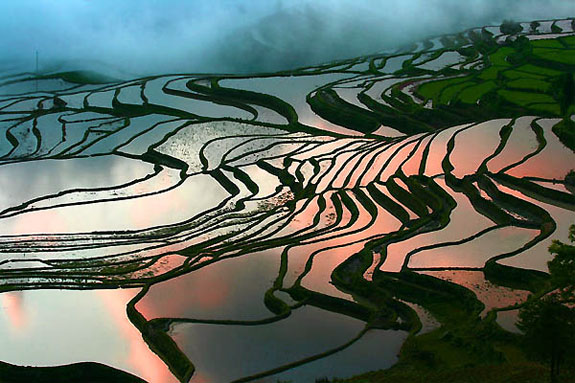
For weeks now my host family has talked about how when the rainy season comes we will farm corn, rice, peanuts, and fonio.  I of course have no experience as a farmer, living in the suburbs my whole like, but my village seems to have made it their mission to turn me into a farmer.  They talk about how we'll find the cows,  (dappitugol nagge), tie them down (hummugol), and use the bulls to pull the ploughs (I forgot the pulaar word for that).  Growing corn and the other crops made sense to me, but I didn't understand how they would grow rice.  When i think of growing rice I think of terraced, flooded rice patties in China, something like this:
There is a Peace Corps China, I wonder what that would be like

The only problem is, so far my site has been more like a savannah.  Well, more like a savannah woodland.  Either way, I didn't see how they would be able to flood the fields enough to sustain rice production.  There are fields and what not, but they are rather dusty and dry, as my previous photos are evidence of (I would re-upload them, but I'm really lazy.  Actually, in my language group that's kind of my nickname: gorko amudo, which means 'lazy boy'".  Anyway, I was talking to a fellow PCV, Cameron, about my site and farming when he came for a visit and I asked them what kind of irrigation or whatnot they used to flood the fields.  His response was "Irrigation? No, they don't flood the fields at all.  God flood the fields".  I've experienced rains at site so far, but it never really rains enough to fill whole fields full of water, so I still had my doubts.  I now understand what he means.  Today was the first real rains of the rainy season.  For the last few days I have been in the lovely town of Salemata for a language seminar.  Today we took the 2 hour drive back through some of the most torrential rains I've ever seen.  The road, not being paved, was in the process of being washed away.  It really was a site to behold as rivers of water washed over the road.  All along the sides of the road then fields had disappeared and in there place was flooded marshland, a perfect rice growing environment.  As we passed the turn-off to my village I looked out the window towards the bush path. Unfortunately, I didn't see a bush path, I saw river flowing over what was my bush path into the laterite road that was slowly itself becoming a river too (sorry I didn't take any pictures).  Anyway, now I see how the village people are able to grow rice.  They just cultivate, but God floods the fields.

Friday, June 14, 2013

One Month At Site

I have been living in Niangue for a little over a month now.  The question that is most often asked of me is what have I been doing all this time at site.  This simple question is both easy and difficult to answer because I don't really do all that much.  I wake up, hang out with people, drink tea, eat meals, and occasionally I'll be invited to do something around the village like make or thatch a roof.  There really isn't much more to say because at this point in my service I'm just trying to become slightly competent in the language and build connections with the people.  Of course, these connections are hard to form if you can't say much more than expressing basic needs.

With that said, I thought I'd make some general observations about my time so far.  So the rainy season has arrived which means that although it's still usually unbearably hot during the day, at night it usually rains.  This rain is always accompanied by thunder and lightning.  Always.  It's quite impressive really, being surrounded by lightning flashes at such  an intensity that there's usually a flash of thunder at least every second.  With the rains have come the grasses.  Grass is something you don't really appreciate until you haven't seen it for months.  It's a striking experience to see the green grasses fill the fields that I've only ever seen as brown.

what is that greeness I see?!

It has gotten significantly greener since  took that picture about a week and a half ago, but since my camera battery seems to be messing up I haven't been able to take any pictures.

So since there isn't really much substantively to talk about my time at site, I thought I'd regal you with a story of adventure!  Well, it was sort of an adventure, and not one that I had intended to take.  Our story starts about 3 weeks ago when I came into Kedougou for the first time since I had gotten to site.  After about 10 days at site I needed to charge electronic devices such as my phone and my ipod, and since Kedougou is the closest place to me to do so, I decided to come on for the day.  Also, I was really craving a hamburger.  Well, being once again in the blissful land of electricity, mostly running water, and internet, soon the day was becoming night.  Since I'd only really been at site for a week I didn't want to sleep at the regional house, so I decided to bike back.  However, it was already 7:00PM and the sun would be going down at around 7:30.  Now I had only ever ridden my bike to site once before during my volunteer visit, and I wasn't quite sure I'd be able to make it back.  I had my phone flashlight though, so what's the worst that could happen... right?

In order to get to my site you have to take a decently well maintained laterite road for about 8km, and then a bush path for about 10km.  

I'm still not quite sure what laterite is

By the time the sun was setting, I was still on the laterite road.  By the time it was completely dark... I was still on the laterite road.  I turned on my phone flashlight, but apparently I had overestimated its strength, as it didn't really even cast enough light to allow me to see the dirt under my treads as I rode on.  I started thinking "this is not good".  Well, there are a bunch of bush paths that turn off of the main laterite road, fortunately mine is marked by a sign saying "Daaka de Bandafassi

A daaka is a sort of muslim retreat.  It comes from the pulaar word for "to camp".  It's basically a muslim sleepover camp in theory.

I knew that the turn off would be approaching, but my flashlight was so weak that I wasn't sure if I'd be able to see it.  I had to stop at every bush path that joined the main road to look for the sign.  I eventually found it, and began to ride down the bush path to my site.  Unfortunately, being that it was pitch black (it was overcast and the moon hadn't risen) and my flashlight sucked, I couldn't see the path under me.  Bush paths aren't really of the highest quality and often have potholes and deep sand and all sorts of things that conspire to dismount a bike-rider.  I only rode my bike for about 5 minutes down the path before I realized that this would not work, so I got off and started walking it.  At this point it should take only 45 minutes to get to my site on bike, but on foot i reckoned it would take around 1.5-2 hours.  Now thus bush-path isn't a straight shot and there are a series of forks and criss-crossing paths.  I looked at my clock and said if I wasn't at site by 9:30, then I'd have to backtrack.

Fortunately, I knew that there would be a few landmarks on my way.  The first would be the seasonal river I'd have to cross.  Calling it a seasonal "river" might be too much, it's more like a seasonal creek.  At this point though it was still dry.  I figured it would take about 45 minutes to get there, so I decided to stave off panic until that point.  If by that time I didn't find the stream, I'd allow myself to panic.  

I think it would be beneficial at this point to paint a mental picture of the state I was in.  There I was, walking my bike down a path I'd only taken once before in my life through the African bush.  My light wasn't strong enough to really see much around me, but I was surrounded by open fields that occasionally would turn into wooded thickets.  It was really quite terrifying.  I kept hearing ruffling in the undergrowth and the calls of strange animals out in the darkness.  Occasionally a field-mouse would run across the path, accounting for the ruffling I heard, but it was hard to not let my imagination run wild.  I'm only about 50km from the national park (also a UNESCO world heritage site) that has lions in it.  Now lions wouldn't range that far from the park... right?  I trod along through the darkness.  I was just starting to get worried when I got to the stream.
apparently it never gets deeper than neck-level

Good, that meant that I was half way there.  I continued along my path slowly narrating my whole adventure in my head as an author would a story.  It was quite odd, but i guess it kept me sane.  Everything was going well, until I got to a fork in the road I wasn't expecting.

two roads diverged in a darkened field

Shoot, well now what?  I really had no idea which to take, and decided to take the left one.  I figured if I didn't get to site in an hour I'd have to turn around, come back to this fork, and take the other one.  Fortunately I chose the right path, as I got to my last landmark.  It's a large rock-bed that apparently isn't made of rocks, as they're not technically classified as such for some reason.  Apparently my ancien liked to point this out. The only problem was, I couldn't make out the path in the field.
they look like rocks to me

I was able to follow the path because I could see the bike-trail running through it.  However, as you can see, rocks aren't good for making out a bike trail.  I decided to walk my bike over it and veer to the right, looking to where the path exited the rock area.  Fortunately I found it and it was only 15 more minutes before I got to site.  All in all I got back at 9:30, when it should have only taken me until 8.  Well, that's my story, I hope you liked it.  It's fortunate that I took the right paths because otherwise I might still be lost out there.


Sunday, May 26, 2013

First Weeks in Nianghe

 For the last week and a half I have been living in the village of Nianghe.  It has been challenging, frustrating, encouraging, and joyful.  I guess it would make the most sense to start at the beginning, so as such, I installed on a Thursday.  The whole ride out towards Nianghe I wasn't sure what to feel.  I guess you could say that so many thoughts were running through my head and I was experiencing so many contradictory emotions that they sort of canceled each other out, likes waves out of phase.  However, as the car got closer and closer my doubts started to dissipate, being replaced by excitement.  As we finally arrived at my village there was a large crowd clapping in beat and saying "Corps de la Paix!"  It was quite overwhelming.  The whole installation went really fast, and before I knew it I was watching the Peace Corps car drive off.

Now what?

My first day in village has actually been like most of the days since.  I went around and greeted people.  I talked to old people.  I drank ataaya (which is tea).  Yeah, it really hasn't been that eventful, so I guess I'll share a few anecdotes and a few pictures.

This is what the typical compound in my village looks like.  It's generally a few huts surrounded by a wood fence (I believe the Pular word is "hogo").

all those black spots on the ground are cow dung.  Seriously, it's everywhere

As for my hut, it's the typical village fare, it looks like this: (that's because this is a picture of my hut)

 That's Assane Diallo, my counterpart, in my hut.  He eats beans.

So you will notice the fence behind my house, that's my backyard!  Yeah, I have a backyard.  Also in my backyard is the latrine area, which is basically a hole I use for the bathroom and to shower.  The thing is, the fence isn't tall enough.  I can look out at the whole village, and that means they can see my head.  This was at first disconcerting, being able to see my whole village as I shower.  People even greet me while I'm showering.  They can only see my head of course, but still.  Yeah, it's still disconcerting.  Tall people problems I suppose
 this is my view when I'm taking a shower

As for the rest of the town, there aren't many landmarks except for the mosque.  Whereas during my volunteer visit the mosque was just a rock circle, they seemed to have built one since then.  It even has a tin roof!  Of course, this also means that they have a place for the call to prayers (they have a solar panel for electricity, they spared no expense).  This wouldn't be too bad, but the call to prayers start at around 5:00 AM, blasted on loudspeakers.  My hut seems to be the closest to the mosque.  I'm not sure if this was on purpose with some ulterior motives, but what it means is that I get the full prayer blast early in the morning.

It's so shiny!

Anyway, it's getting late and I need to leave back to village before the sun goes down, so I'll share one experience in village so far.  So I am basically the most popular person in village because my parents (thank you) sent me a soccer ball.  Being the only soccer ball in the village, the kids are always asking to play with it.  One day I was playing soccer with about 20 people when a man rode up on his bike.  He seemed upset and yelled some stuff in Pular.  Of course, I could not understand it, but it seemed to end the soccer game.  As I looked around in confusion someone came up to me and spoke to me in French.  All I really caught was "une vache est tombee".  He also used hand gestures getting the point across that the cow seemed to have fallen in a hole.  That couldn't be good, there were pot-holes everywhere, easy to sprain an ankle in.  Sprained ancles aren't good for livestock.  Everyone started walking over to where the man had come from, and they told me to follow them.  As I approached the hut I didn't see any cows anywhere, all I saw was the hut, the fence, and a well...

Everyone was gathered around the well.  Why would that be?  Peering down into the well, I saw the cow sitting there knee deep in water.  Well, that's a problem, how were they going to get the cow out of the well?  How had the cow gotten in the well?  Apparently it was an unobservant cow and had just fallen in.  Or, it could have been seeking a thrilling watery adventure.  As a fellow PCV Courtney said, if it wanted a watery adventure it could have headed over to the seasonal river.  The cow must have realized that the seasonal river hasn't filled up yet (but it's starting to).  Regardless of the bovine motives, the fact remained that there was a cow 40 feet down a well.  I don't know how, but they had tied a rope around the top of it's head, around the horns.  (A note about cows here, the males and females have horns, I don't know why).  Anyway, everyone lined up along the rope to play some tug-of-war against a gravity-bound cow.  I thought that they couldn't be serious, they'd pull the poor cow's head right off.  I could just imagine it lying limp being raised out of a well with a rope around its head.  Of course, I'm not a cow expert, so I went along with it.  With shouts of "Allez!" we pulled and pulled and pulled until the cow emerged from its watery prison.  First its head, then its body, then it was on the ground.  Everyone looked happy and the cow was still in one piece.  People were shaking hands and I turned around to congratulate the man behind me.  As we shook hands I heard shouts of "Dogu!"

The pular didn't really register as I was tired from pulling a cow out of a well.  Of course, Dogu is the imperative form of the verb "dogugol", which means "to run".  Looking behind me I saw men running away.  I also saw the cow with it's head lowered, preparing to charge.  The cow was visibly pissed.  Seriously, pulling a cow out of a well by the head does not make for a happy cow.  As people ran it mock charged, but never really committed.  We all got away and the cow went back to pasture.  Anyway, a typical day in village I guess, time will tell what the next few weeks have in store, Inshallah.


Wednesday, May 15, 2013

Ready to Install

I haven't written in a while, and a lot has happened since I last wrote.  Last Wednesday I took my language proficiency interview.  This is a pass/no pass test that measures your capacity in the local language you are learning.  If you pass you are sworn in as a volunteer and leave for your site, if not you stay in Thies for another week and then take it again.  Thankfully I passed my Pullo Fuuta test, meaning my path to volunteer-hood was set.  Last Friday we went to the Ambassador's house in Dakar and swore in as peace corps volunteers.  On Sunday we all drove to our separate sites, myself and 4 others going to Kedougou.  Since then I have been chillin at the regional house waiting for my installation, which is tomorrow.

When I last wrote a blog post I had just learned what site I would be going to when my pre-service training ended.  I had just learned I would be going to Nianghe, a small village of around 300 near Bandafassi in the region of Kedougou.  While at the time it seemed like an eternity away, the time has come and passed, and I am now a sworn-in Peace Corps Volunteer.  When I last wrote I was imagining what Kedougou would be like, and as I write this I sit in the regional house of that town.

Needless to say, a lot has happened over the past month.  Though I could write entire blog entries about all the things that have happened (and at the time I'd planned to), it seems more fitting in my current mindset to simply recount some of the more interesting experiences of the last month.

The first event that really stands out is our volunteer visit.  This is a time when every trainee takes a trip of around 5 days to their future sites.  This meant that I and the other four Kedougou volunteers would be traveling down to visit our sites.  However, since Kedougou is one of the furthest regions from Thies we had to leave at 6AM.  I'm not sure how well you know my morning habits, but it would be safe to say that I wouldn't be considered a morning person.  Thus groggily I arose at 5:45 less tired than I was excited to see where I would be living for two years.  The trip down took only 9 and a half hours, which meant we made great time.  Our peace corps driver Idrissa is quite the speed-demon.  As I drowsed in and out of sleep I saw the Senegalese countryside change from brown and sandy to slightly less brown and sandy.  An interesting fact about the road from Thies to Kedougou is that it goes straight through a national park (that is also a UNESCO world heritage site) between Tambacounda and Kedougou.  This is about 2 hours out of Kedougou proper.  The second we entered the park we saw warthogs and baboons and all other sorts of monkeys.  While this was still sinking in we drove over the verdant Gambia River.  It was then that I knew I was no longer in the desert.

As we got closer and closer to Kedougou where there was once brown shrublands and sand there was now green shrubland and trees.  The flat elevation rose to rolling hills.  And all at once we were at the end of the road, entering Kedougou and arriving at the regional house.

The storage center of the regional house

I have been at the regional house for the last few days and I thought it would be an interesting place to talk about.  The Kedougou regional house has one of the most unique feels of any place I've ever been to.  If I had to describe it, it would be a frat house meets a summer camp.  All the volunteers here are very welcoming and cool people.  So the regional house isn't really a house; it's a series of huts.  Here is the sleeping hut:
It's actually called the "Disco Hut"

Please note the Bassari style roof thatching, as opposed to the Pular style which is apparently inferior.  I guess I haven't provided a picture of the Pular style to compare it, but just imagine this hut with thatch that doesnt look quite as good.  We also have an extensive library:

Apparently there were some Hawaiians who dropped by

My actual site visit was amazing.  I'm not sure if you remember from my previous post, but in Senegal there is a tradition of having a joking relationship with people of a certain last name.  As a Diallo up to this point, I have a joking relationship with the Ba's.  I could say something like "ko honto woni be'i an?  Hari o wujji be" (I think this means "Where are my sheep?  You must have stolen them", of course my Pullo Fuuta isn't great so it could mean something else).  In my stage there are two other girls who are Ba's, and I've been making fun of them for most of PST.  Well, when I arrived in Nianghe I learned that of the 300 people there, half of them are Diallos and the other half are Bas.  Like, no joke.  It's the most hilarious thing.  They literally spend the whole day making fun of each other over odd things like sucking roots or stealing mangos.  In the spirit of this they decided to give me a new name.  This is done in a ceremony called a "denabo", or a baby naming ceremony.  Everything was going well until they had to actually chose a name for me.  Half of them wanted me to be a Diallo, the other half wanted me to be a Ba.  It got rather heated.  Understandably, being a Diallo up until this point I secretly wanted them to name me a Diallo, but I had no say in the matter.  After a while of uncertainty they called the village Imam over.  He then gave a lengthy speech and gave me the name Hammidy Ba.  That's right, I'm a Ba now.  It's like a little piece of me died.

An amusing note about the Denabo: it's supposed to be for babies.  There are specific prayers you say when performing a Denabo.  I was wondering why my volunteer host was trying not to crack up during the prayers, and I only learned after that it was because the whole time the Imam was calling me a baby.  Things like "may Allah bless this little baby, born here only weeks ago.  When he grows hair may he become big and strong".

Another interesting story from my visit to Kedougou:  We were walking through town to get some hamburgers (yes, the regional capital has just about anything you could need), when all of a sudden we saw a large procession going through.  It was obviously some sort of celebration.  As we walked on we saw men dressed up in grass shirts and wooden masks and carrying bamboo sticks walking with the procession.  My volunteer host says
 "oh shoot, these guys are gonna hit us".
  I was confused at this statement, as the bamboo armed men approached. 
"yeah, you gotta dodge these guys, those sticks really hurt"
I manage to get away from all of them, but one of them clearly caught eye of my volunteer host, something that wasn't hard to do since he's white... and we're in Africa.  He lifted up his bamboo bludgeon, pointing it at my host like Babe Ruth calling his next shot.  Though he dodge, the stick was too fast.  Anyway, I learned after than apparently these men are traditional parts of celebrations and they drive out evil spirits from people by whacking them with sticks.

The next eventful... event of my pre-service training was the Popenguine weekend.  POPENGUINE!!! It was fun, we swam, sat on rocks, look at my facebook photos.

Next was the counterpart workshop.  It was intimidating.

If my writing gets more brisk, or perchance more pedestrian, I apologize.  I'm getting tired of writing, but the show must go on I suppose. 

As the weeks flew by, the end of my CBT approached.  CBT was the time where I lived with a host family near Thies and they helped me learn the language.  It was an odd sensation.  For the last 2 months I had been living with this family and slowly getting to know them as my language improved; but just as I was getting to truly know them I would have to go.  It was a struggle at times, but my CBT family were always inviting, welcoming, just all in all good people:

looking sharp

I am going to miss my CBT family.  Also, I am going to miss the food.  It was seriously amazing.  As an example here is one of my favorite dishes.  It's rice and fish balls and carrots and stuff.  The fish balls are like meatballs, they really are delicious

mmm fish balls

So here I am now.  In the regional house in Kedougou.  Tomorrow morning I go to my site to begin my life there for 2 years.  It is exciting and terrifying.  I've heard that it's a formative experience standing in your village, watching the peace corps car drive away, and thinking "now I truly am on my own".